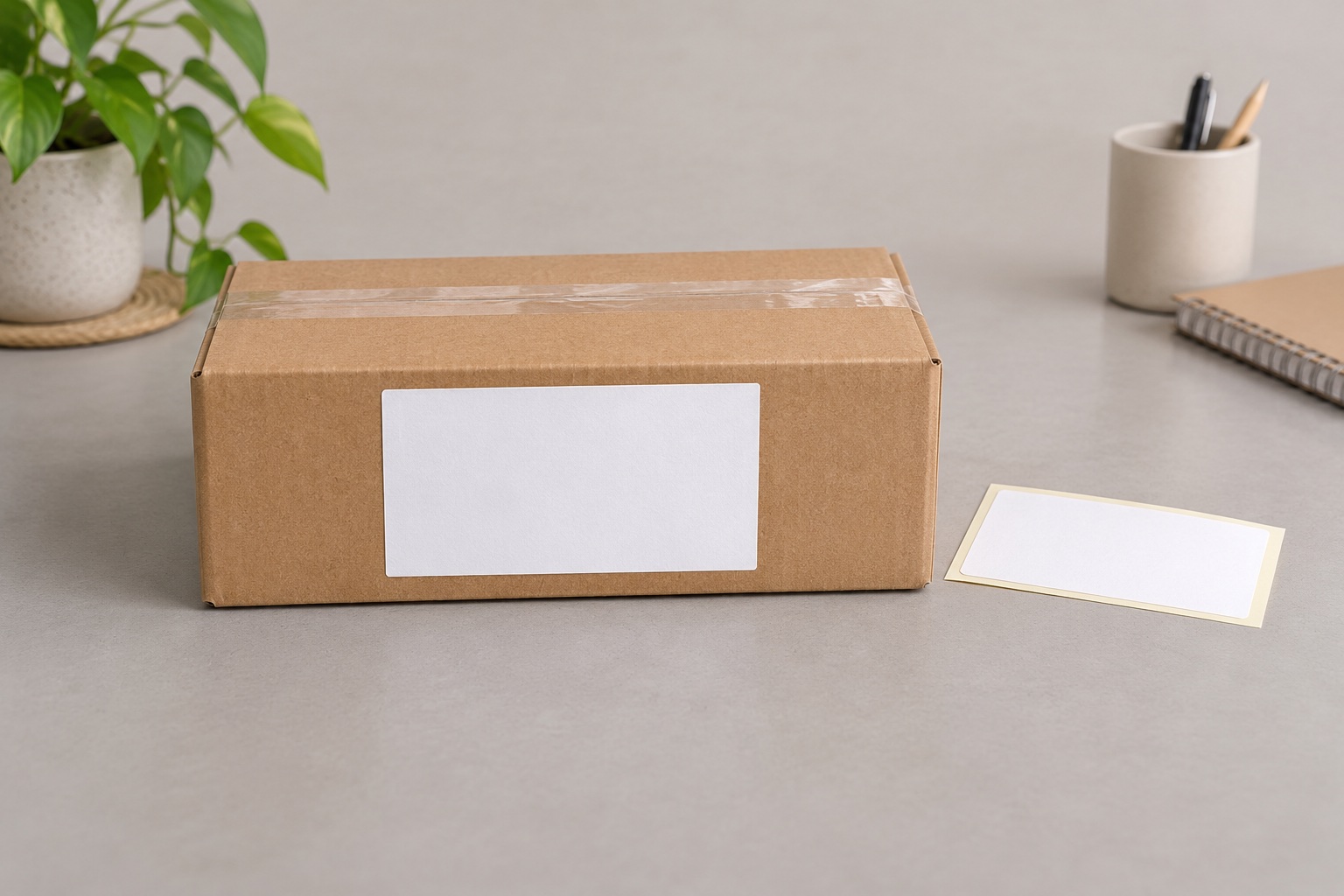
Look at the outside of the box before changing labels
Two brown cartons can behave differently under the same shipping label. One has a smooth, firm outer surface. Another sheds dust or has a coarse texture. A printed gift box may have a gloss coating, while a reused carton may have paper fibres exposed where an old label came off. Identify the patch you plan to label and check how much flat, undamaged space it offers.
Pressure-sensitive label adhesive needs contact with the surface. Avery Dennison identifies rough substrates and recycled cardboard among the applications suited to some hot-melt adhesive formulations. That supports checking the finished label's surface suitability when general stock lifts. Ask the label supplier about its specific adhesive on your cardboard, especially if you buy cartons from several sources. Avery Dennison hot-melt adhesive guide
| Surface or condition | What to inspect | What to try |
|---|---|---|
| Smooth, plain cardboard | Dust, dampness and enough flat space | A compatible parcel label applied with even pressure. |
| Coarse or recycled board | Loose fibres and shallow surface contact | A sample recommended for rough or recycled carton surfaces. |
| Gloss-coated or heavily printed box | The coating where the label will sit | A supplier-confirmed label and a test on that coating. |
| Reused box with torn outer paper | Firmness of the remaining outer layer | A sound patch elsewhere or different packaging. |
| Cold box brought into a warm room | Condensation and the label's application conditions | Let sound, dry packaging reach suitable conditions before labelling. |
| Seam, taped join or fold | A raised ridge or unsupported edge under the label | Move the entire label onto a flat face. |
Match the finished label to the printer and the box
The adhesive is one part of the choice. The label also has to feed through the printer, print clearly and fit the postage layout. Read the media specification for the exact printer and the size offered by your carrier. Check whether the label is direct thermal, designed for a laser printer or designed for an inkjet printer before considering its sticking performance.
For a compatible external-feed direct thermal shipping printer using a true 4 × 6 inch output, a pack of MUNBYN fanfold labels is one existing option to sample on your cartons. The selected pack contains 500 labels measuring 101.6 × 152.4 mm. Check the printer's feed and gap settings. Use the first few labels to confirm both the print and adhesion on your actual packing materials. MUNBYN UK shipping labels · MUNBYN media and gap setup
Open-format fanfold supply
MUNBYN 4 × 6 inch fanfold shipping labels
A 500-label fanfold pack for compatible direct thermal shipping printers. The folded stack sits behind the printer and feeds without putting a large roll inside the machine.
Keep in mind. Check the actual printer’s width, gap sensing and feed instructions. These open-format labels are a different system from Brother DK holders and DYMO’s Series 5 authenticated rolls.
- 4 × 6 inch format
- 500 fanfold labels
- Direct thermal media
A pack advertised as strong adhesive still needs to pass the same carton test. For a rough board or a cold packing area, ask for the intended substrate and minimum application conditions. A statement about resistance once a label is attached describes a different stage from putting it on in the first place. Avery Dennison adhesive technology guide
Apply one sample to a clean, dry, flat patch
- Check the carton is sound and the outer paper is firmly attached. Clear loose dry dust without soaking or abrading the board.
- Seal the parcel and find a flat area that will take the whole label. Leave the seams and corners clear.
- Keep the label and box dry and within the label supplier's application conditions. If cold packaging has condensation on it, wait until it is dry before testing.
- Peel the backing while holding the label at its edges. Start at one edge on the flat box and smooth the strip across, pressing evenly over the whole surface and corners.
Avery's application guide calls for clean, dry materials, controlled application and appropriate temperature. It shows applying to a box from one edge across the surface to reduce wrinkles. Handle the adhesive as little as possible. Avery label application guidance
Check the bond after the parcel has been handled
Use a spare sealed box or a representative sample of the carton you intend to buy. Note which label stock and cardboard you used. Apply the same size label in the same place as a real shipment. Check it after the period specified by the supplier and after normal packing-room handling. For a new carton source, repeat the check on a second box from the batch.
Look for an end that lifts, a bubble across the barcode or a layer of cardboard coming away with the label. If the label bonds well but takes loose paper with it, inspect the carton surface. If it stays flat on one carton finish and lifts on another, keep those results separate when choosing stock.
For an unusual environment, describe it to the supplier before choosing the label. Include whether you apply to a cold surface, store packed boxes near a door or expect condensation. A room-temperature sample alone cannot establish performance through every condition in transit.
Find the cause before adding another strip over it
If only the corners lift, check whether the label crosses a fold, tape ridge or seam. If the entire strip releases easily, inspect for dust, grease, moisture or the wrong surface specification. If a label wrinkles as the packed box bulges, check the box size and where pressure from the contents falls.
Correct the surface or placement and apply a fresh label. Cover any old routing code completely where your carrier allows it, or remove it before relabelling. Keep the current address and barcode clear and flat. Some carriers, including DHL Express, specifically direct senders to keep tape and paperwork off the label. DHL Express UK labelling guidance
Manufacturer and carrier guidance
Common questions
What label adhesive works on cardboard boxes?
Choose a finished shipping label whose supplier supports the actual cardboard and conditions you use. A general-purpose permanent label may work on smooth, dry board. Recycled, rough or coated board deserves a sample test before a large purchase.
Why do labels peel off recycled cardboard?
The surface can be uneven, dusty or loosely fibred, reducing contact with the adhesive. Check that the box is sound and dry, apply firm pressure and compare a sample on another clean patch.
Should I put a shipping label over clear packing tape?
Prefer a clean flat area of the box where the entire label can make contact. Tape creates a different surface, and seams or tape ridges can lift the label. Test a coated or taped surface if you have to use it and follow your carrier's placement guidance.
Does a waterproof label automatically stick better?
A label's resistance to moisture and its ability to bond to a particular surface are different specifications. Check the adhesive, the face material and the application conditions for the exact finished label.
Will generic 4 × 6 fanfold labels fit every parcel printer?
Check the printer's media width, external-feed path and sensor requirements. The featured open-format direct thermal pack is for compatible shipping printers. Brother DK machines and DYMO LabelWriter 550 models have their own media requirements.