Measure the finished parcel before choosing a band
Pack the item with the protection it needs, seal it and attach any paperwork that adds to the outside. Measure the parcel in that condition. A book's listed dimensions or a box manufacturer's internal size can help you choose packaging, but the carrier handles the whole finished parcel. A bulging closure, folded flap or padded corner can be the point that sets its maximum size.
Use a clear space on a level table. Set the parcel down so you can see its full outline and note three outside measurements in centimetres. Record the weight in grams or kilograms alongside them. Keep those numbers with the order until the label and service are confirmed. Royal Mail asks customers buying online postage to weigh the item including its box and packing materials. Royal Mail measuring guidance
Take the three outside measurements
- Measure the longest side and record it as length. Keep the tape or ruler straight between the two furthest points.
- Measure the next side across the package and record the width. Look along both edges to check whether one side bulges farther out.
- Measure the depth or height from the table to the highest point. For a soft mailing bag, check the thickest part with the contents in their normal packed position.
- Repeat any measurement that sits close to a limit. Use millimetres when you need to resolve a small difference, then convert consistently for the booking form.
Use two upright flat objects as reference points for a parcel with rounded sides. Bring them gently against its widest points, then measure the clear distance between them. Keep the normal shape of the package. For a long flexible item, check its shape and dimensions against the chosen service's instructions before booking.
A retractable tape suits a rigid box when you can hold it straight. A ruler helps with a shallow packet, and a flexible tape can help measure circumference when the service asks for it. Choose the tool around the measurement, then check which scale on it is centimetres.
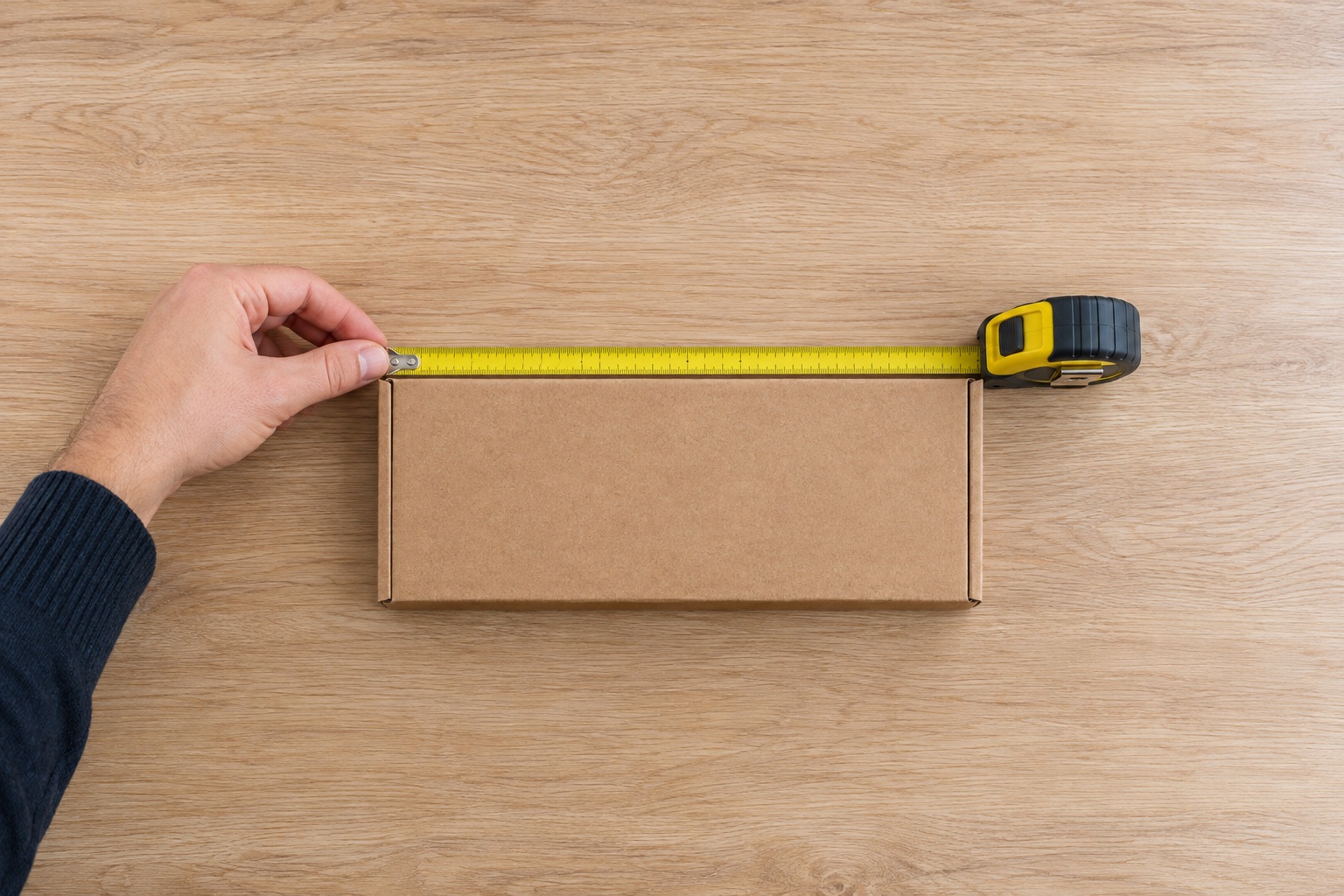
The Stanley Tylon example below is a 5 m tape with a 19 mm blade. On a rigid box, hold it straight along the outside edge and read the centimetre scale at the furthest point. Keep the same method for all three sides.
For the sealed parcel dimensions
STANLEY Tylon 5 m tape measure
A retractable 5 m tape measure with a 19 mm blade for measuring the outside of a packed parcel.
Keep in mind. Measure the parcel’s greatest outside points and confirm the units against the carrier’s limits.
- 5 m measuring length
- 19 mm blade
- Model 0-30-697
Compare every measurement with the chosen service
Start with the exact service rather than a carrier-wide assumption. For Royal Mail UK 2nd Class, compare all three outside dimensions and the packed weight with the chosen format. A light parcel can fail on depth, and a compact parcel can fail on weight. The examples below keep those checks separate.
Royal Mail · UK 2nd Class
Which check changes the format?
These illustrative examples use fully packed rectangular packets and boxes. Dimensions are length × width × depth, with the longest side first. Each side and the complete weight must meet the selected format's limits.
| UK 2nd Class format | Maximum outside dimensions | Maximum packed weight |
|---|---|---|
| Large Letter | 35.3 × 25 × 2.5 cm | 750 g |
| Small Parcel | 45 × 35 × 16 cm | 2 kg |
| Medium Parcel | 61 × 46 × 46 cm | 20 kg |
Royal Mail's 2nd Class limits. These examples cover Large Letter, Small Parcel and Medium Parcel. Letters, tubes, rolls, international services and other Royal Mail products need their own rules.
| Packed example | Format checked | Outside size checks | Packed weight | Decision and reason |
|---|---|---|---|---|
| 35.3 × 25 × 2.5 cm750 g packed | Large Letter |
| 750 g / 750 gAt limit | At published maximum All four values reach the published maxima. Remeasure the sealed packet before booking. |
| 35 × 24 × 2.6 cm700 g packed | Large Letter |
| 700 g / 750 gWithin | Exceeds this format The 2.6 cm depth exceeds 2.5 cm, even though the packet is light. Small Parcel contains these dimensions and weight; check its price bracket and other booking conditions. |
| 45 × 35 × 16 cm2 kg packed | Small Parcel |
| 2 kg / 2 kgAt limit | At published maximum All sides and the weight reach the Small Parcel maxima. No allowance remains for a bulge or added packing. |
| 40 × 30 × 17 cm900 g packed | Small Parcel |
| 900 g / 2 kgWithin | Exceeds this format The 17 cm depth is 1 cm over Small Parcel's depth limit. Medium Parcel contains these dimensions and weight; check its price bracket and other booking conditions. |
| 44 × 34 × 15 cm2.1 kg packed | Small Parcel |
| 2.1 kg / 2 kgOver | Exceeds this format The sides fit Small Parcel, but 2.1 kg exceeds its 2 kg weight limit. Medium Parcel contains these dimensions and weight; check its price bracket and other booking conditions. |
| 61 × 46 × 46 cm20 kg packed | Medium Parcel |
| 20 kg / 20 kgAt limit | At published maximum All four values reach the Medium Parcel maxima. Confirm final measurements and the correct weight bracket. |
| 61.1 × 46 × 46 cm5 kg packed | Medium Parcel |
| 5 kg / 20 kgWithin | Exceeds this format The longest side is 1 mm over 61 cm. This fails the Medium Parcel size test. Choose a different supported service or suitable packing arrangement. |
| 60 × 45 × 45 cm20.001 kg packed | Medium Parcel |
| 20.001 kg / 20 kgOver | Exceeds this format The dimensions fit, but 20.001 kg is 1 g above the maximum. Choose a different supported service or suitable packing arrangement. |
Check the exact service you are buying and the handover location. A service's maximum parcel size and a locker compartment or posting aperture are separate checks. If you intend to use a locker, look up the compartment limits and the booking instructions before choosing the packaging. A parcel that needs forcing through an opening needs another supported handover method.
Weigh the complete package and read the result clearly
Place a suitable scale on a firm, level surface and check that the platform reads zero. Put the entire parcel on it, with its weight supported by the platform. Make sure it is clear of the wall, table edge, loose packing and other objects. A large box can touch something outside the platform and change the reading.
Wait for the measurement to settle, note the unit and check the number again. If the box hides the display, use the scale's supported separate display or hold function according to its manual. Check that the scale capacity and resolution suit the range of parcels you send. For a reading near a service threshold, repeat it and use a scale with enough resolution to settle the choice. Choosing a home dispatch scale
For heavier boxes
MUNBYN IPS01 30 kg postal scale
A higher-capacity postal scale with a backlit display and hold and tare functions.
Keep in mind. Check whether large boxes sit securely and whether the parcel service accepts their packed dimensions and weight.
- 30 kg capacity
- Backlit display
- Hold and tare
Record the full packed weight before purchasing a label. Include the outer box or mailer, cushioning, tape and any contents added after the first weighing. If you add a thank-you card, reinforce a corner or replace the box, recheck the final parcel. A packing recipe can speed up repeated orders, but periodic checks catch changes in item weight or packaging.
Use combined-size rules only where the service asks for them
Some carriers ask for length plus circumference. Evri's guide describes adding the two shorter sides, multiplying their sum by two and then adding the longest side. That total has its own limit alongside the longest-side and packed-weight limits. The worked examples below show why passing one condition cannot compensate for failing another.
For a form asking for three dimensions, enter the three dimensions. Keep any derived total in a separate note so you can check the carrier's rule without confusing it with the length, width or depth fields. International and specialist services may calculate chargeable weight differently. Use the calculator and instructions for the exact product selected.
Evri · UK ParcelShop or courier collection
Check length, the combined measurement and weight separately
Use these examples for the published UK ParcelShop/courier size-and-weight checks. Marketplace labels, international bookings and specialist products can have their own conditions. Locker compartment fit is an additional check.
Published maximum for ParcelShop or courier routes.
Published boundary; confirm the exact-245 cm case below.
Include the box, protection, tape and all contents.
Reviewed November 2026 against Evri's size and weight guide and sending FAQ.
Take the longest side as length. The other two sides form the circumference calculation. The result is a length in centimetres, not a volume in cubic centimetres.
| Packed example | Longest side | Length + circumference | Packed weight | Decision and reason |
|---|---|---|---|---|
| 60 × 30 × 20 cm2 kg packed | 60 cm / 120 cmWithin | 160 cm60 + 2 × (30 + 20)Within | 2 kg / 15 kgWithin | Within these limits All three checks are below the stated boundaries. Still check the booked route and contents. |
| 120 × 30 × 30 cm15 kg packed | 120 cm / 120 cmAt limit | 240 cm120 + 2 × (30 + 30)Within | 15 kg / 15 kgAt limit | At stated maximum Length and weight reach their stated maxima; the combined measurement is 240 cm. Recheck the finished parcel. |
| 121 × 20 × 20 cm2 kg packed | 121 cm / 120 cmOver | 201 cm121 + 2 × (20 + 20)Within | 2 kg / 15 kgWithin | Exceeds a limit A low combined measurement cannot offset a 121 cm longest side. |
| 100 × 40 × 32 cm2 kg packed | 100 cm / 120 cmWithin | 244 cm100 + 2 × (40 + 32)Within | 2 kg / 15 kgWithin | Within these limits 244 cm is below the combined-size boundary; longest side and weight also fit. |
| 100 × 40 × 32.5 cm2 kg packed | 100 cm / 120 cmWithin | 245 cm100 + 2 × (40 + 32.5)245 cm boundary | 2 kg / 15 kgWithin | Confirm 245 cm boundary Exactly 245 cm. Evri's public boundary wording differs; confirm the exact booking rather than assuming acceptance. |
| 100 × 40 × 33 cm2 kg packed | 100 cm / 120 cmWithin | 246 cm100 + 2 × (40 + 33)Over | 2 kg / 15 kgWithin | Exceeds a limit The 100 cm longest side fits, but the 246 cm combined measurement exceeds 245 cm. |
| 60 × 30 × 20 cm15.001 kg packed | 60 cm / 120 cmWithin | 160 cm60 + 2 × (30 + 20)Within | 15.001 kg / 15 kgOver | Exceeds a limit Dimensions fit the stated tests, but 15.001 kg is 1 g above 15 kg. |
A size-and-weight match is one part of booking. Check the contents, destination and handover route too. A parcel within the network limits can still exceed a locker compartment: use the dimensions and available compartment for the actual location. Evri locker guidance.
Keep a repeatable record and check the final booking
For a regular item, record its packing method, external dimensions and typical packed weight. Give the packaging a clear reference so a later replacement can be checked against it. If you switch to a larger mailer or thicker cushioning, measure a fresh sample before reusing the saved numbers.
At the booking step, compare the entered dimensions and weight with your note. Check the service, destination and chosen drop-off or collection route. Then read the issued label and attach it to the correct order. If the actual parcel changes after booking, use the provider's correction process before handing it over.
Carrier sources
Carrier limits and the worked comparisons were reviewed in November 2026. The examples are calculations using the stated packed dimensions and weights. They identify size-and-weight outcomes; the carrier's current booking conditions determine whether a particular shipment can be sent.
Common questions
Do I measure the item or the packed parcel?
Measure the fully packed and sealed parcel at its outside limits. Weigh it with the box or mailer, cushioning, tape and any other contents included.
Can a light parcel be too large for a Royal Mail Small Parcel?
Yes. For UK 2nd Class, the Small Parcel maximum is 45 × 35 × 16 cm and 2 kg. A parcel must fit every dimension and meet the weight limit.
Should I add the three parcel dimensions together?
Enter the three measurements separately when the booking asks for length, width and depth. Evri's combined-size calculation for the routes described here is the longest side plus twice the sum of the other two sides. A 60 × 30 × 20 cm box gives 160 cm; it must also meet the separate length and weight limits.
How do I measure a bulging mailing bag?
Measure the outside at the widest and thickest points with the contents packed normally. Include the bulge and closure in the dimensions and check the service’s shape guidance.
Does meeting the carrier's size limit mean my parcel fits a locker?
Check the actual locker compartment separately. A carrier's network size and weight limits can allow parcels that are too large for a particular compartment. Use the selected service, location and available compartment instructions, and choose another supported handover method if needed.